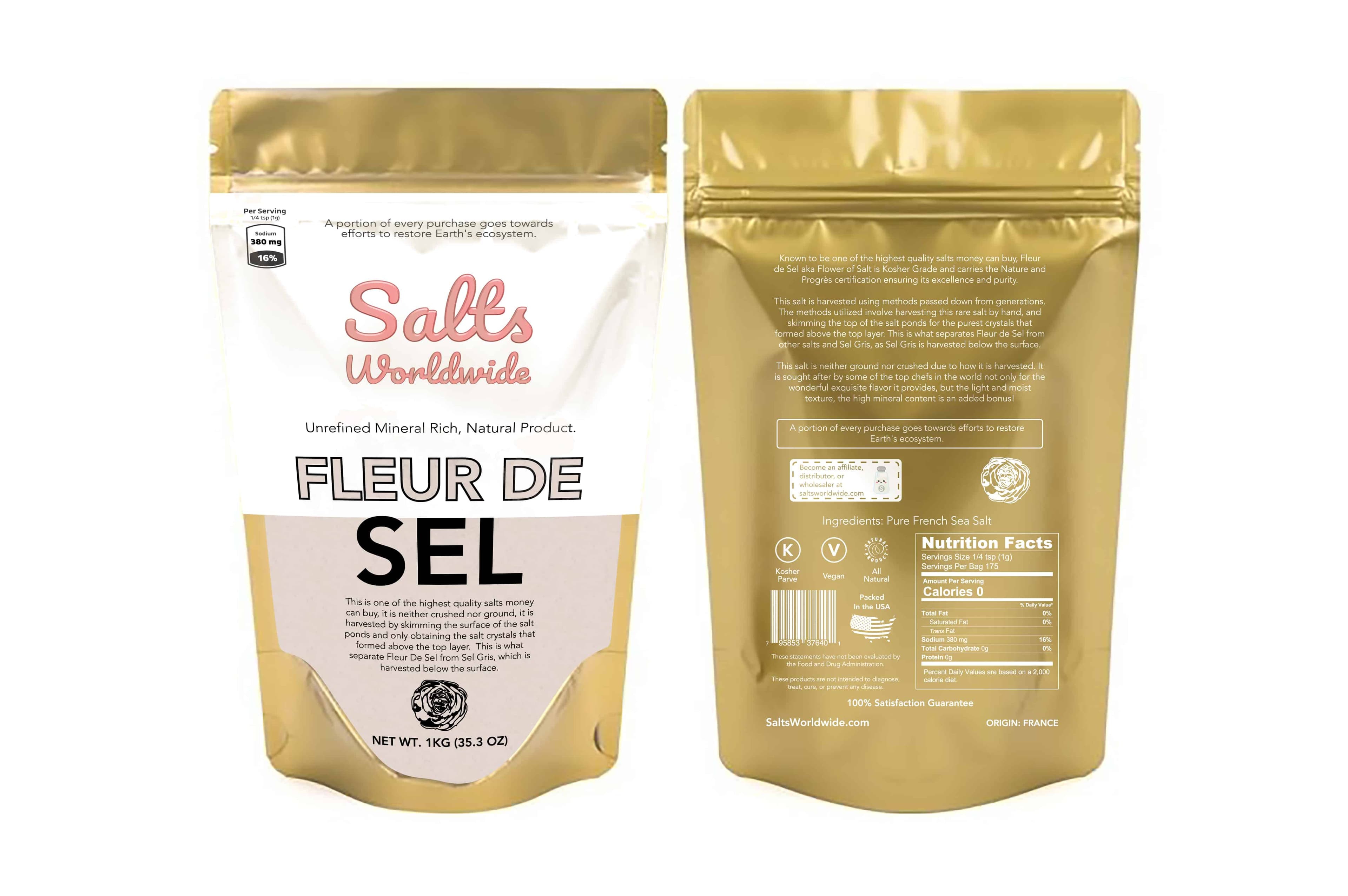
What makes Fleur de Sel distinct?
Fleur de Sel is one of the classic finishing salts of French cooking. The name means "flower of salt," a reference to the delicate crystals that form on the surface of shallow salt pans under the right combination of sun, wind, and careful timing. Instead of being harvested as heavy bulk salt from the bottom of a pan, Fleur de Sel is skimmed from the surface while the crystals are still light, fragile, and slightly moist.
That harvest method is what gives Fleur de Sel its reputation. The flakes are small, irregular, and tender rather than hard and aggressive. They dissolve slowly enough to give a clean pop of salinity at the table, but they are delicate enough that they do not feel coarse or gravelly. This makes the salt especially useful when the final texture matters as much as the seasoning.
Fleur de Sel belongs near the end of cooking. It is not the salt to pour into pasta water or hide inside a long-simmered soup. Use it where it can be seen and felt: over roasted vegetables, sliced steak, tomatoes, fresh cheese, buttered bread, caramels, chocolate, fruit, or a finished salad. A small pinch can make a simple plate feel complete.
What is Fleur de Sel used for?
Fleur de Sel is used as a finishing salt. Add it after cooking, just before serving, so the crystals keep their shape and texture. A pinch over warm food gives a brief crunch and then melts into the surface. On cold dishes, it adds contrast without the sharpness that can come from a heavy hand with finer salt.
It is excellent on vegetables because it does not need much support. Try it over roasted carrots, blistered green beans, grilled corn, sliced radishes with butter, or tomatoes with olive oil. It is equally useful on protein: steak, chicken, fish, eggs, and shellfish all benefit from a few flakes added after cooking. For sweets, Fleur de Sel is a natural partner for caramel, brownies, cookies, citrus, and ripe melon.
Because it is a premium finishing salt, use it where you will notice it. Season the inside of a recipe with a more economical cooking salt, then finish with Fleur de Sel at the table. That approach gives you the texture you paid for without using delicate flakes in places where they will simply dissolve and disappear.
Flavor, texture, and mineral profile
Fleur de Sel has a bright, clean briny flavor and a gentle crunch. The crystals are not perfectly uniform, which is part of the charm. Some are paper-thin flakes, while others are tiny clusters. That variation makes each pinch feel more natural than a finely processed salt.
The salt often retains a little moisture from the salt marsh, so it may feel soft or slightly damp compared with dry table salt. That moisture helps the flakes cling to food. It also means the salt should be stored with care: keep it covered, use a dry spoon or clean fingers, and avoid leaving it beside steam.
Mineral traces in Fleur de Sel reflect the seawater and salt-marsh environment where it forms. They contribute to color, aroma, and subtle flavor differences from one harvest region to another. As with any finishing salt, the most important practical differences are crystal shape, moisture, and how the salt lands on the tongue.
How to use Fleur de Sel well
Keep a small dish of Fleur de Sel near the serving area rather than near the stove. Heat and steam can make the salt clump, and the best use is at the end. Take a small pinch between your fingers and sprinkle from a little height so the flakes scatter evenly.
On vegetables and salads, add it after oil or dressing so the crystals cling to the surface. On meat and fish, season during cooking with another salt if needed, then add Fleur de Sel only as the final accent. On desserts, use a very small amount. The goal is contrast, not a salty dessert.
If you are substituting Fleur de Sel for another salt in a recipe, remember that it is less dense by volume than fine salt and more noticeable on the surface. For precise recipes, use weight. For finishing, trust your fingers and taste in small increments.
When to choose Fleur de Sel over another salt
Choose Fleur de Sel when the final pinch is part of the eating experience. It is especially strong on foods that are already cooked, sliced, dressed, or plated. The crystals should be visible enough to invite a bite and delicate enough to disappear as you chew. That is why it is so often paired with simple foods: a ripe tomato, a soft-boiled egg, a seared steak, a piece of dark chocolate, or bread with good butter.
If you are building a salt pantry, think of Fleur de Sel as the finishing layer. Keep a less expensive cooking salt for pasta water, soups, and baking. Keep French Grey Salt if you want a moist salt-marsh crystal that can work during cooking. Keep Himalayan Salt if you want a dry grinder salt. Fleur de Sel earns its place when you can feel the flake and see the final scatter.
It is also a useful hosting salt. A small dish of Fleur de Sel beside sliced radishes, fresh cheese, grilled vegetables, or caramels lets guests season individual bites. Because the salt is delicate, the dish does not need a large spoon or heavy pour. A small pinch with clean dry fingers is usually enough.
For gifting or pantry storage, protect the texture. Keep the salt in a sealed jar away from steam, and avoid transferring it to a grinder. Grinding defeats the reason to buy it. The value is in the natural crystal shape, the slight moisture, and the way a few flakes can finish a plate with restraint.